

![410 FEND '65-SR | '65 Fender™ Super Reverb [Black Face] | '65 CTS™ 4×10″ | Cabinet Impulse Response](http://tacosounds.com/cdn/shop/files/410-fend-65-sr_main.jpg?v=1777550872&width=100)




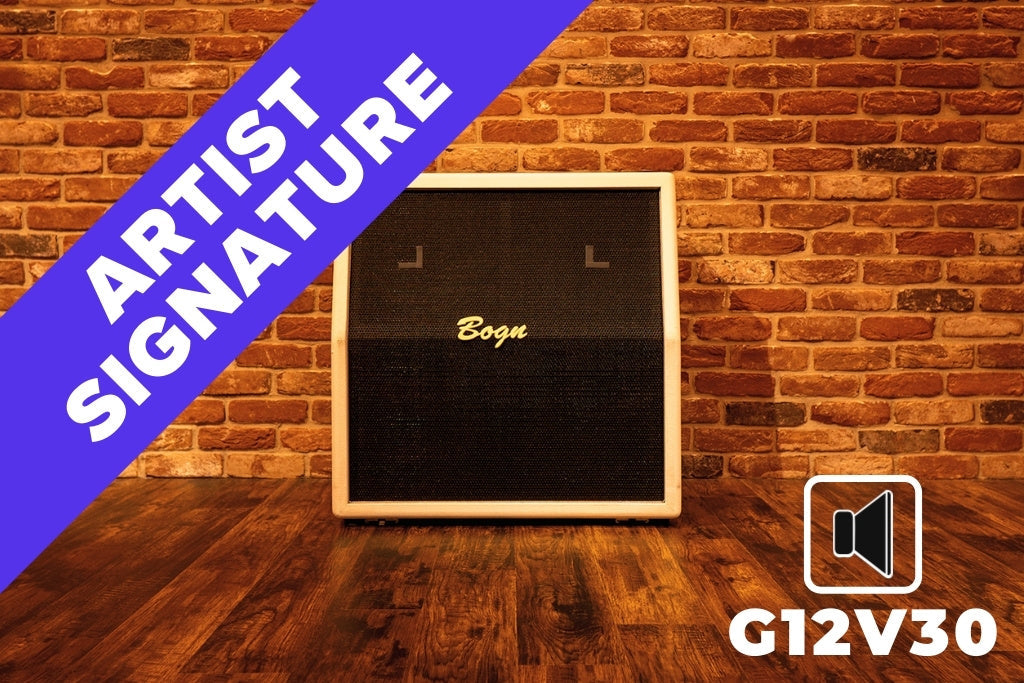
The Bogner™ 4×12 slant-front cabinet loaded with four Celestion™ G12V30 speakers, captured as Hiroshi Shibasaki's signature IR set. The cabinet Shibasaki reaches for on modern high-gain work and on precise rhythm parts where clarity matters more than warmth. Built from dense wood panels with reinforced internal bracing, this is a tight enclosure — stiffer than a typical British 4×12, with low-end transients that settle quickly and minimal cabinet resonance. What you hear stays close to what the speakers and amp put out.
Speakers and why Shibasaki chose this cabinet
Four Celestion™ G12V30 (Vintage 30) drivers, 60W power handling, 75Hz cone, with a pronounced upper-mid peak around 2kHz. Aggressive midrange, attack contours that hold up under heavy distortion, and enough low-end weight to anchor double-tracked rhythm guitar. This is the character that established the V30 as the modern high-gain reference. The stiff Bogner cabinet paired with the V30's forward midrange delivers tight low end and upper-mid definition that cuts through dense arrangements. A rig prepared for modern high-gain rhythm work, tight palm mutes, and lead lines that need to sit in front of the mix.
Microphone capture — 11 single + 111 mixed-mic IRs
Six microphones across 11 positions, combined into 111 mixed-mic IRs including ratio variations between mic pairs. Placement and tonal balance entirely under Shibasaki's supervision, with each position chosen against a specific image of how this cabinet should sit within a mix. The tight cabinet behavior of the Bogner™ slant, the forward midrange and defined attack of the V30, and Shibasaki's mic discipline are preserved here as a tonal fingerprint for modern high-gain and precision rhythm work.

Bonus Gift: SHIBASAKI's AXE-FX III Presets
Two Shibasaki's presets (16 tones via SCENE) | For FW14.05 - Preamp/tone differs in newer ver.
Tight, articulate low-end with substantial weight and clarity. Suits modern high-gain tones and precise rhythm work.
Single Mics
Files marked with f are far position — recorded slightly further from the cabinet than the standard close-mic, capturing a touch more air and room interaction. Other suffixes (v1, v2, off) indicate alternative placements or rotations.


Mix Files
Two mics blended at fixed ratios. The numbers in the filename (e.g. 3-7) indicate the blend ratio. Below are three representative examples (57III + R121); the full library contains many more combinations.
Microphones Used

01 / dynamic
57IIISM57 Unidyne III
based on a Shure™ SM57 Unidyne III
The most-used dynamic mic in rock history. Tight, punchy midrange — the standard close-mic on guitar cabs since the 1960s.

02 / dynamic
906e906
based on a Sennheiser™ e906
Modern dynamic with flat-design body — sits flush against the grill. Tight midrange focus, easy to position.

03 / dynamic
M421MD421
based on a Sennheiser™ MD421
Large dynamic mic with detailed response and bold low-end. A studio standard on guitar cabs and toms.

04 / condenser
offU87
based on a Neumann™ U87
Studio standard large-diaphragm condenser. Off-axis position.

05 / ribbon
R121R-121
based on a Royer Labs™ R-121
Premium ribbon microphone with smooth frequency response and natural sound reproduction.

06 / ribbon
VR1
based on a sE Electronics™ VR1
Ribbon microphone with warm, smooth low-mids. Tames harshness and adds a vintage-tape character.

Shibasaki Hiroshi
WANDS
Since his 1991 debut as the founding guitarist of WANDS, Shibasaki has been at the forefront of Japanese rock through the band's multi-million-selling run. His work extends to artists such as abingdon boys school, T.M.Revolution, and Nanase Aikawa, among many others, while he continues to stay active across a wide range of band, session, and live performance projects today.